

Earth's Unlikely Formation Overcame the Obstacles to Intelligent Life
The development of eukaryotes was a crucial step
A previous article described how the Earth acquired large oceans and other characteristics making it suitable for life. The prebiotic molecules that help kick-start living organisms can be found throughout the universe hitchhiking on meteorites and comets. Here we look at how single-celled organisms, which occur naturally on a watery world, developed the ability to evolve into multicellular organisms, and much later, intelligent life.
Obstacle 5 – Only One Form of Prokaryote
The first primitive single-celled organisms to appear on Earth were prokaryotes, consisting of bacteria and archaea. But the evolution of two prokaryote forms may have required a large ocean. The presumed last universal common ancestor (LUCA) of prokaryotes had evolved about half of the enzymes for the 420 chemical reactions that make up the metabolic network known as metabolism. The other chemical reactions were catalyzed using metals in the environment where LUCA occurred, suggesting that life originated around undersea hydrothermal vents and LUCA was not yet a living organism.
LUCA is defined as having the current common enzyme processes of both bacteria and archaea. The original LUCA may have had a somewhat different set as either or both lineages may have replaced some of what were then common enzymes.
Apparently, the bacteria and archaea lineages evolved in different environments after LUCA, possibly due to a major deep ocean disturbance which displaced a large percentage of the population. Afterwards, each evolved divergent enzyme replacements for the remaining metal catalysts used in their separate chemical environments, and became free-floating organisms with differing capabilities. The result was two or more prokaryote forms, with at least two required for eukaryotes to develop.
Obstacle 6 – No Eukaryotes
Prokaryotes have a problem. As they grow larger, their volume and energy needs increase much faster than their surface area. Since they obtain energy by interacting with their environment through their outer surface, they quickly reach a size limit and must stay tiny.
A chance solution to the energy problem resulted when a new cell type, the eukaryote, emerged. Unlike prokaryotes, a eukaryote has an internal membrane-bound nucleus and other internal organelles, one being a mitochondria, which provides far more energy than could be produced by the cell itself. Only single-celled organisms called eukaryotes have the energy and size to evolve into complex multicellular organisms. Without eukaryotes, intelligent life cannot evolve.
Photosynthetic bacteria which produce oxygen gas as a waste product evolved early in Earth's history. Eventually, their production of oxygen made it so abundant that it led to a world-wide catastrophe for prokaryotes. Non-oxygen producing prokaryotes were forced to mutate to be compatible with oxygen, or die.
The first eukaryote came about as a merger between two cell types, an anaerobic (oxygen incompatible) archaeon and an aerobic (oxygen compatible) bacterium. The aerobic bacterium became the mitochondria of the archaeon, and the merger became an alternative way for at least one species of archaea to survive oxygenation.
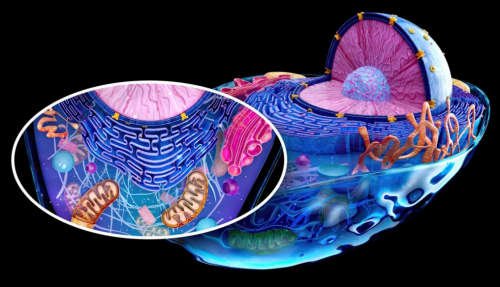
There was a relatively short time frame when oxygen stress was beginning to kill many prokaryotes, but before all anaerobic cells died. The merger came about in part because of unique characteristics of the two cells.
At least one species of archaeon had developed a DNA mutation that provided greater flexibility of its cell membrane, allowing it to surround objects touching it, and pull them inside for ingestion. It also had folds in its outer skin to provide greater surface area. In addition, this innovation allowed it to wall off internal structures like its nucleus.
When an aerobic bacterium slipped into a fold of the archaeon, possibly as a parasite, the archaeon engulfed it. The captured aerobic bacterium had its own unique DNA. It could perform a chemical exchange with the archaeon by consuming oxygen molecules, and supplying it with energy in the form of ATP molecules as a waste product.
This led to a symbiotic arrangement where the archaeon did not consume the aerobic, but kept it as an organelle. The short time frame for this arrangement to occur, plus the rare DNA capability and compatibility of both cells, make the formation of eukaryotes an unlikely event.
Mitochondria create far more energy than a prokaryote can produce on its own. Eukaryotes with mitochondria are able to grow much larger than prokaryotes, create more elaborate DNA, and evolve into complex multicellular organisms that lead to intelligent life.
So now we see the presence of intelligent life on Earth as the lucky result a series of improbable events. Once Earth had become a planet suitable for life, two forms of prokaryotes developed, archaea and bacteria. Next, the oxygenation of oceans due to photosynthetic bacteria triggered the development of eukaryotes, and with them, a path to multicellular intelligent life. The odds of all this happening in the habitable zone of any solar system to produce an Earth-like water world with a stable sun are very low. This is one of the reasons why we have no visitors from other planets.
Dennis Evans
© 2023-2026 by Topicnews.org
Questions or comments? Email info@TopicNews.org